

The Grain Equation: How El Niño Is Shaping India’s Food Outlook
– by Audrija Bhattacharya l Project Coordinator UK, The Celestial Earth l Econ & Econ History, London School of Economics
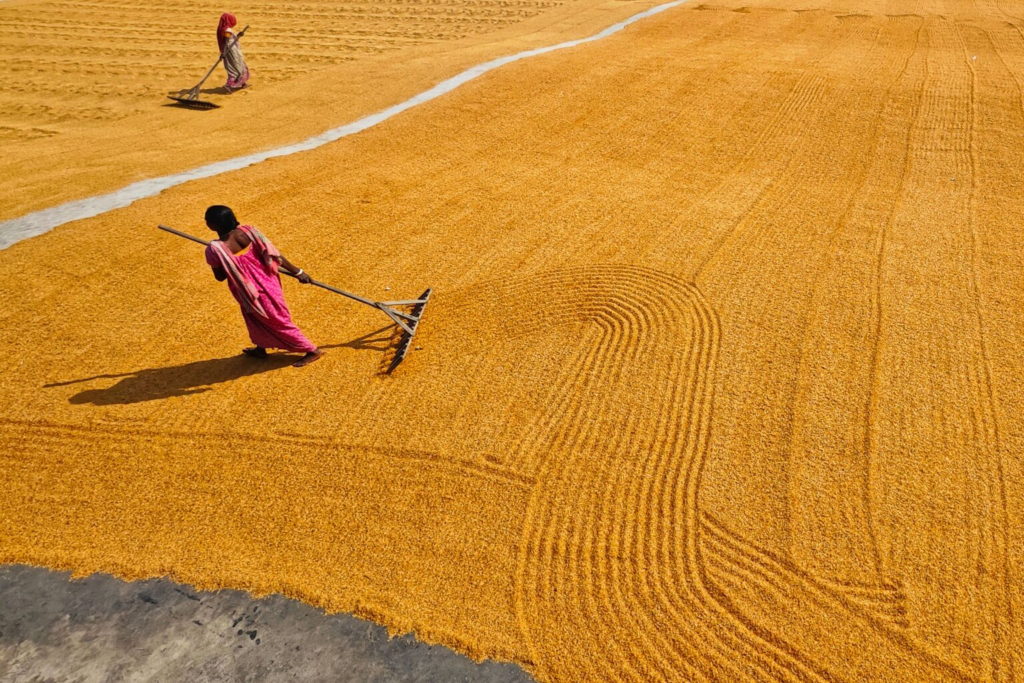
Source: Photo by Dibakar Roy @pexels
A country sitting on record grain reserves is still watching the latest El Niño wave unfolds with visible unease — why? India’s wheat and rice stocks currently sit comfortably above the government’s mandated national requirement, a cushion that should, in theory, blunt El Niño’s usual bite into domestic food supply. Yet that surplus hasn’t been enough to settle nerves, because this year’s El Niño is on track to become one of the most severe on record. Forecasters at the US’s National Oceanic and Atmospheric Administration have assigned a greater than 90% probability of the event reaching “very strong” intensity through the winter of 2026-27.
El Niño is a natural climate pattern that recurs every two to seven years, triggered by warmer-than-usual sea-surface temperatures in the eastern Pacific Ocean. Its effects ripple outward unevenly across the globe, but for India, the most consequential one is close to home: a weakening of the monsoon winds that carry rain across the subcontinent each summer.
India is no stranger to what that weakening can do. Its most recent experience with El Niño, in 2023, dragged the monsoon down to a five-year low of 94% of the Long Period Average – a modest-sounding shortfall that nonetheless drove August 2023 into the driest month in over a century and pushed farm sector growth down to just 1.4% for the year.
Three years on, the pattern is repeating itself, more severely. As of mid-September 2026, the monsoon ended with a nationwide deficit of roughly 14%, with the southern peninsula down a sharp 27%. Kharif sowing lagged badly in Maharashtra, Karnataka, and Odisha through the season, and ratings agency ICRA now projects agricultural GVA growth for FY27 at just around 1.2% – a level that would mark one of the weaker years for Indian farm output in recent memory.
How El Niño transmits into the economy –
El Niño transmits itself into the Indian economy through two distinct channels, and it’s worth keeping them separate rather than lumping every price pressure together as “El Niño’s fault.”
The first is the one most people think of: weaker monsoons hitting grain production directly, tightening food supply and pushing up prices for staples that make up a heavy share of what ordinary households spend on.
The second is less obvious but growing in importance: rising heat driving a surge in cooling demand. As temperatures climb, air-conditioner use spikes, and India’s electricity grid has to find the extra generation from somewhere. The Centre for Research on Energy and Clean Air (CREA) estimates that this El Niño could force India to generate an extra 17.7 terawatt-hours of fossil-fuel power over the year, roughly 10 terawatt-hours of that driven by air-conditioning demand alone, equivalent to about a quarter of Delhi’s entire annual electricity consumption. Weaker monsoon winds compound the problem by lowering wind and hydropower output at the same time demand is rising, pushing utilities further toward coal and raising both emissions and generation costs. That energy-side pressure is being sharpened further by the ongoing conflict in West Asia, which has kept global crude oil prices elevated. It is a geopolitical shock layered on top of a climate one, hitting India’s energy import bill specifically rather than its food basket.
RBI’s Approach to El Niño –
The Reserve Bank of India has explicitly flagged El Niño as a key risk to its inflation outlook, yet its Monetary Policy Committee held the repo rate steady at 5.25% with a neutral policy stance at its August 2026 meeting, projecting headline inflation to peak near 5.9% in the third quarter before easing. The RBI’s comfort, by its own account, rests on “proactive supply management and adequate foodgrain stocks” — in simpler terms, on the very grain surplus that opened this essay. Healthy reservoir levels and longer-term government efforts around crop diversification and water conservation are expected to offer the farm sector some further cushion, even if this year’s rains have already done their damage.
This is a notably calmer central bank than the one India had in 2023-24, when food- driven inflation fears kept the RBI’s rate unchanged at 6.5% for nearly two years running. The difference isn’t that this El Niño is weaker (by most measures it’s stronger), it’s that the government now has a much bigger buffer sitting in its granaries.
Shift in Government’s Policy –
That buffer has produced a genuinely interesting shift in policy. In 2023, facing a comparatively milder shortfall, the government moved defensively and fast: it banned exports of non-basmati rice to keep domestic supply secure and prices in check, a move that rattled global rice markets given India’s outsized share of world exports.
This time, the government has done the opposite. It lifted its rice export restrictions in March 2025 and ended a four-year-old wheat export ban in early 2026, betting that record stockpiles – rice reserves are near 53 million tonnes against a mandated buffer of just 13.5 million tonnes, wheat near 18 million tonnes against a requirement of roughly 7.5 million tonnes – give it room to keep trading rather than hoard. It’s a more confident posture, though not an unconditional one: trade authorities have kept the option to reimpose restrictions if domestic inflation breaches 5% or the kharif harvest disappoints further.
That confidence, however, doesn’t extend evenly to everyone the policy touches. Despite the government raising minimum support prices (MSP) for 14 kharif crops this season, the sheer size of existing buffer stocks has slowed official procurement, leaving many farmers selling wheat, maize, and bajra in the open market below the support price meant to protect them. The aggregate story — ample grain, a calm central bank, a government confident enough to keep exporting — sits uneasily next to a farm economy where individual growers are still absorbing the shortfall in their own incomes.
Why El Niño Remains a Matter of Concern –
Record reserves have genuinely changed how this El Niño is playing out for India, compared to three years ago – the food-price panic of 2023 hasn’t repeated itself, at least not yet. But the underlying exposure hasn’t gone away; it has simply moved. It shows up in strained power grids and rising coal use rather than empty granaries, in oil-import bills swollen by a war half a continent away, and in farmers selling below the price the government itself set for them. India’s buffers have gotten better at absorbing the shock at the national level. Whether that shock still lands, quietly, on the people least able to absorb it, remains the open question this El Niño is still answering.